
rsvp
When to Set Your Wedding RSVP Deadline
When to send RSVP requests, when to set the deadline, and what to do when guests still haven't replied — a practical timeline that actually works.
Read articlePaper RSVP cards have a certain charm. The reality of using them — lost cards, handwriting you can't read, manual tallying — is less charming. An honest comparison.
Published on
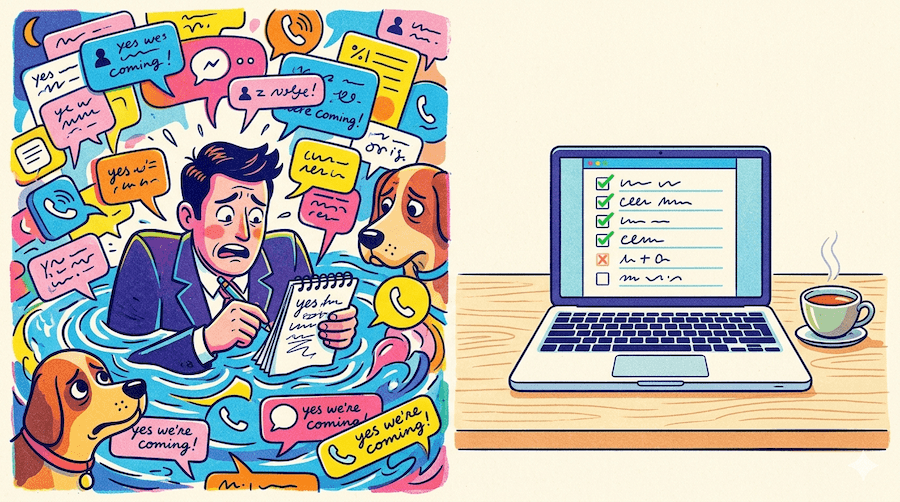
Paper RSVP cards have a certain appeal. A small, well-designed card in a matching envelope feels considered — part of a complete invitation suite that guests open, hold, and remember. There's a tactile quality to it that no link can replicate.
The experience of actually using paper RSVP cards to manage a guest list, on the other hand, is considerably less charming.
This article doesn't exist to tell you paper is bad. It exists to give you an honest picture of what each approach actually involves — so you can make the right call for your wedding rather than the one that looks nicest on a stationery mood board.
Paper RSVP cards work well in a specific set of circumstances.
For elderly guests and less tech-comfortable guests, a stamped card that just needs a tick and a postbox is genuinely the easiest option. No link to follow, no form to fill in, no device to navigate. For a significant portion of older guests, this matters.
For small, intimate weddings — under 25 or 30 guests — where you know every person well and can personally follow up the handful who don't reply, the manual overhead of paper is manageable.
For very formal weddings where the invitation suite is a central part of the aesthetic, a matching reply card is a considered design choice that fits the whole thing together.
In these scenarios, paper is a legitimate choice with real advantages.
Here's what typically happens at a wedding with 80 or 100 guests and paper RSVP cards.
Some cards come back promptly, filled in correctly, with names and meal choices clearly legible. Those guests are fine.
Several cards arrive with no name — just a meal selection tick, sent from an envelope with handwriting you can't identify.
A few are lost in the post entirely. You won't know they were lost until you follow up and the guest is surprised you haven't heard.
Some guests leave the card on their kitchen counter for three weeks. The return-by date passes. You start texting people, which means the paper RSVP process has already been supplemented by WhatsApp.
You're now manually transcribing every response — name, headcount, dietary requirement — from physical cards into whatever spreadsheet you're using to track everything. Any card that comes in late needs to be found and reconciled. Any change after the deadline needs to be updated by hand.
The hidden cost of paper RSVP isn't the printing. It's the hours of human administration required to turn a pile of handwritten cards into a usable guest count.
The core difference is simple: one place for all responses, updated automatically.
When you use an online RSVP tool:
Your headcount is always current. Every response updates the count immediately. You don't tally at the end — you just look.
You can see exactly who hasn't replied. Filter your guest list to "no response" in seconds. Send a targeted reminder to only those people, rather than a mass message to everyone.
Dietary requirements are stored next to the guest. No hunting through a pile of cards trying to remember whose handwriting that was. Every note is linked to a name.
Plus-ones are attached to their invitations. You know exactly who "Emily and guest" refers to — and whether the plus-one is coming or not.
Late changes are visible immediately. Someone who confirmed needs to cancel? They update the form or you update it for them. The count adjusts. You don't need to remember to cross something out on a spreadsheet.
For guests, a well-implemented online RSVP is actually easier than a paper card — one link, two minutes, done from their phone. The friction is lower, not higher.
This concern is worth taking seriously — and worth examining clearly.
For the majority of guests under 60, filling in an online form via a link on their phone is genuinely simple. The process is: tap a link, tick a few answers, press submit. No account creation, no app download, no password. If guests can book a restaurant on OpenTable or buy something on Amazon, they can fill in an RSVP form.
For older guests who genuinely find this difficult, the right approach isn't to switch everyone to paper cards. It's to have a plan for those specific guests: take their response by phone and enter it yourself. You spend five minutes per guest; they experience zero friction; everything ends up in one place.
Most couples who insist their guests "won't use online" find that the vast majority do, without issue — and that the handful who don't are easily handled with a phone call.
Here's what usually happens in practice when couples choose paper RSVP: cards go out with the invitations. Some come back. Some don't. The non-responders get chased by text and WhatsApp. Those responses are jotted down informally. Eventually there are responses in three different places and a spreadsheet that's two weeks out of date.
If that's the likely outcome, starting with an online RSVP and handling non-digital guests manually is a shorter route to the same result — with far less administrative work along the way.
A sensible hybrid looks like this:
This works. It doesn't require every guest to be comfortable with technology. It just requires you to be the one who bridges any gaps.
If none of these apply, the case for paper is mostly aesthetic.
| Paper RSVP card | Online RSVP form | |
|---|---|---|
| Easy for guests? | Familiar, requires posting | Link-click, two minutes |
| Easy for you? | Manual transcription required | Automatic |
| Tracking who's replied | Physical pile + spreadsheet | Filtered list in seconds |
| Dietary requirements | Card → manual entry | Stored per guest |
| Chasing non-responders | Hard to identify; requires memory | Filter "no response" instantly |
| Late changes | Update spreadsheet manually | Guest or you updates the form |
| Works for large weddings? | High admin overhead | Yes |
| Works for small weddings? | Yes | Yes |
Can I use both paper and online RSVP? You can, but it means managing two response streams manually. A better version of "both" is online as the primary method, with you entering paper or phone responses on behalf of guests who use those instead. Everything ends up in one place, with half the admin.
What if some guests won't fill in an online form? Take their response however they give it — phone, text, via a relative — and enter it yourself. The goal is one accurate record. How each guest gets their answer to you is secondary.
Do guests need to create an account to use an online RSVP form? No. With Celebrate's RSVP tool, guests click a link, fill in the form, and submit. No registration, no password, nothing to download.
What about the experience for guests — isn't receiving a card nicer? Paper invitations can absolutely be kept for the experience of receiving them. The RSVP doesn't have to match. Many couples send beautiful paper invitations with a note pointing to the wedding website for RSVP — getting the warmth of the physical invitation and the practicality of digital responses.
Is paper RSVP dying out? Quickly, yes — at least as the primary response method. Most couples now use online RSVP as the default and include paper response cards only for specific guests or specific aesthetics. The admin difference is significant enough that most couples who try both never go back.
Collect all your RSVPs in one place with Celebrate's online RSVP tool. Responses feed directly into your guest list — no cards to transcribe, no spreadsheet to maintain.
Celebrate gives you all the tools to plan your perfect event — guest list, RSVPs, seating, and more.
Start for free →When to send RSVP requests, when to set the deadline, and what to do when guests still haven't replied — a practical timeline that actually works.
Read articleThe right questions to put on your wedding RSVP form — and the ones that hurt your response rate. With ready-to-copy examples.
Read articlePolite, ready-to-use RSVP reminder messages for WhatsApp, text, and email, plus a follow-up schedule that helps you close your guest list on time.
Read article